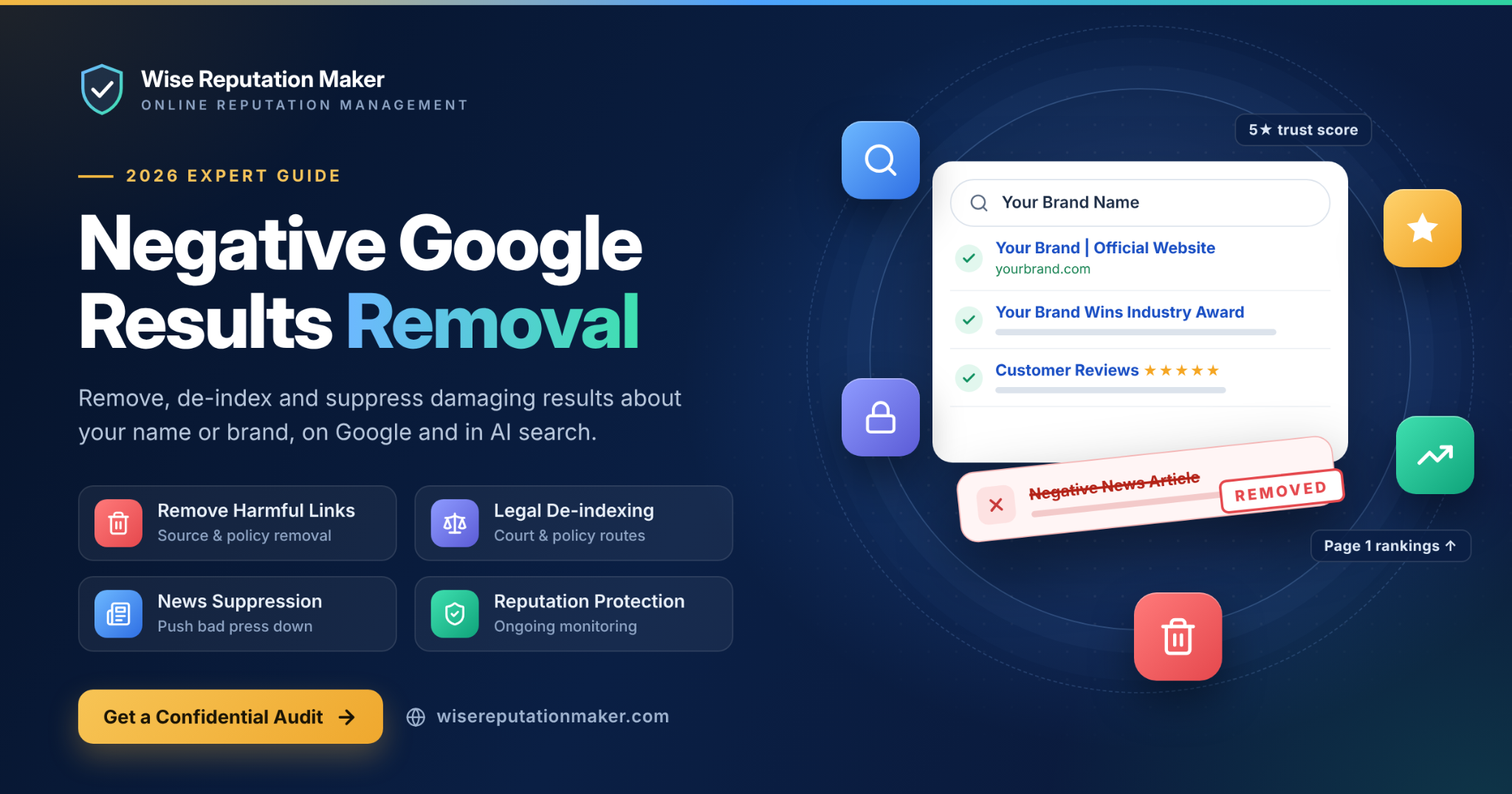
Your search results are now your first meeting
Before a buyer signs, an investor wires money or a recruiter calls back, someone types a name into Google. What appears in the next few seconds often decides the outcome. In 2026 that page will no longer have ten blue links. It is a stack of news carousels, image packs, autocomplete suggestions, “People also ask” boxes and AI-written summaries, and each one can carry a single damaging story further than the original article ever travelled.
This is why negative Google results removal has moved from a crisis-only service to a standing part of how serious brands and professionals manage risk. Done properly, it is closer to legal and technical case work than to marketing: every harmful URL is assessed, routed to the right removal mechanism, and, where removal is not possible, outranked by assets that search engines and AI systems trust more.
Key takeaways
• Negative Google results removal works through three routes: deletion at the source, de-indexing under Google policy or law, and engineered suppression.
• Google removes content from its index, not from the internet. The publisher still controls the original page.
• Personal data, doxxing, non-consensual imagery, copyright misuse and court-ordered content have formal removal paths. Accurate but unflattering coverage usually needs suppression.
• AI Overviews and answer engines draw on page-one sources, so cleaning page one also changes what AI says about you.
• Removals typically take days to a few weeks; suppression shows measurable movement in 2 to 3 months.
Where negative content hides on a modern results page
A reputation audit that only checks the ten organic links misses most of the exposure. Damaging material now surfaces in at least seven places, and each needs a different fix.
| Search feature | What typically shows up | Why it matters | Primary fix |
| Organic results | News articles, blogs, complaint pages, court portals | Still the most-clicked area of the page | Removal, de-indexing, or suppression |
| Top Stories and News tab | Recent press, often syndicated across many outlets | One story can occupy several slots. | Publisher outreach, positive press |
| Images | Mugshots, screenshots, out-of-context photos | Images are remembered longer than text | Source removal, image de-indexing, owned imagery |
| Autocomplete | “[name] fraud”, “[brand] scam” style suggestions | Plants doubt before the search is complete. | Policy reporting, shifting search demand |
| People also ask | Questions framed around a controversy | Frames the narrative for every visitor | Authoritative answer content |
| Reviews and local pack | Low ratings, fake or retaliatory reviews | Directly hits conversion and inquiries | Policy flagging, review generation |
| AI Overviews and Answer Engines | Summaries that repeat negative sources | Presents the story as settled fact | Changing the sources AI draws on |
The last row is the one most audits still ignore. AI summaries are assembled from pages that already rank, so a single unresolved article can be restated as a neutral-sounding fact at the very top of the page.
The removability matrix: what can go, and by which route
The single biggest factor in negative Google results removal is matching each URL to the correct mechanism. Google states plainly that it removes results from its index, not the page itself, and that it generally does not remove content simply because it is unflattering. The work is in knowing which doors are actually open.
| Content type | Strongest route | Realistic outcome |
| Private contact details, ID numbers, and bank or medical data | Google’s personal information policy and the Results About You tool | Removal from search, full or for name-based queries |
| Doxxing or threatening posts | Google doxxing policy, platform reporting | De-indexing and takedown |
| Non-consensual intimate or AI-generated explicit imagery | Google’s dedicated removal request | De-indexing, with similar copies demoted |
| Content on sites that charge to remove it | Google’s exploitative removal practices policy | De-indexing or demotion of the site |
| Copied photos, articles, or brand assets | DMCA copyright notices and trademark notices | Removal of the infringing URLs |
| Defamatory content | Court order or legal notice to the publisher | Removal at source; de-indexing with a valid order |
| Posts on social platforms and forums in India | Grievance Officer under the IT Rules, 2021, then the Grievance Appellate Committee | Takedown where content breaches the rules |
| Outdated news or edited pages | Publisher update request, then Google’s Refresh Outdated Content tool | Corrected snippet or dropped result |
| Accurate but damaging coverage | Engineered suppression | Moved off page one |
India’s Digital Personal Data Protection Rules, 2025, notified in November 2025 and phasing in over the following months, will add further erasure rights against organizations that hold personal data. They do not replace the routes above, but they strengthen requests made directly to data-holding businesses.
The Wise Reputation Maker Page-One Recovery Framework
Wise Reputation Maker runs every engagement through five phases. Each one produces a defined deliverable, so progress is visible from the first week rather than promised for later.
| Phase | What happens | Deliverable | Typical timing |
| 1. Search exposure audit | Every result for the name or brand is mapped across web, news, images, autocomplete, and AI answers, then scored for visibility and action. | Risk-ranked URL register | Week 1 |
| 2. Route assignment | Each URL is classified using the removability matrix: source removal, policy de-indexing, legal action, or suppression. | Removal and suppression plan | Week 1 to 2 |
| 3. Removal execution | Publisher outreach, Google policy requests, platform grievances, and legal notices are filed and tracked. | Request log with status per URL | Days to a few weeks |
| 4. Suppression build | Owned and earned assets are created, optimized, and linked so they outrank what remains. | Asset portfolio and ranking reports | Clear movement in 2 to 3 months |
| 5. Protection | Ongoing monitoring of rankings, new mentions, reviews, and AI answers | Monthly reputation report and alerts | Ongoing |
The order matters. Building positive content before the audit wastes budget on the wrong keywords, and filing requests without route assignment invites rejections that are harder to reverse.
Service architecture: matching the problem to the right specialization
Since 2015, Wise Reputation Maker has built its practice around one idea: negative Google results removal is rarely solved by a single tactic. Each service below handles a specific part of the problem, and most engagements combine several.
Removal and remediation
| Search problem | Wise Reputation Maker service | What it delivers |
| Harmful URLs with a legal or policy basis | Negative Link Removal | Removal through legal and policy routes |
| Damaging links and news on page one | Negative Links and News | Removal or suppression so they leave page one |
| Critical press that cannot be taken down | News Suppression | Damaging coverage pushed down with credible positive press |
| Arrest photos and litigation records | Mugshots and Lawsuits | Mugshot removal and legal records moved out of view. |
| Old disputes and misleading posts | Unfair Past Experiences | Past controversies addressed and outranked |
| Hostile threads on Reddit, Quora, and complaint boards | Forum Clean-Up | Policy-based reporting and balanced visibility |
| Fake or retaliatory reviews | Review Management | Fake reviews flagged; genuine ratings grew. |
| Thin or missing positive presence | Reputation Build-Up | Personal websites, profiles, and press features |
Strategic programs
• Online Reputation Management: the full program that builds, protects, and improves how a name or brand appears online.
• Personal Reputation Management: for founders, executives, doctors, lawyers, and other professionals whose name search shapes their careers.
• Brand Reputation Management: for companies whose brand search affects sales, hiring, and investor confidence.
Visibility engines
• Search Engine Optimization, or SEO: the technical and content discipline that makes positive assets rank and the engine behind every suppression campaign.
• Social Media Marketing: active, authoritative social profiles that hold page-one positions and signal a current, credible presence.
Suppression is engineered, not posted.
Publishing a few press releases and hoping they rank is not suppression. A negative article on an established news domain carries years of authority, and it will only move if something stronger and more relevant takes its place. Professional suppression treats page one as ten slots to win, one at a time.
• Own the entity. A well-structured personal or brand website, consistent profiles, and schema markup help Google recognize exactly who or what the search is about.
• Choose assets that can outrank. Professional profiles, industry publications, interviews, video channels, and high-authority social accounts each compete for a different slot.
• Answer the questions people ask. Clear, factual content that responds to “People also ask” queries reclaims the space a controversy would otherwise frame.
• Earn credible mentions. Independent coverage and citations carry more weight than self-published claims.
• Write for answer engines too. AI Overviews, ChatGPT, Perplexity, and Gemini favor sources that are factual, well structured, and consistent across the web. Assets built this way change what AI systems say, not only what ranks.
This is where negative Google results removal and generative engine optimization meet: the same trusted, accurate sources that push a damaging page down also become the material AI uses to describe you.
How success is measured
Reputation work should be reported in numbers, not impressions. These are the measures a credible program tracks from the baseline audit onward:
| Metric | What it shows |
| Negative URLs on page one | The core outcome: how many harmful results remain in the top ten |
| Average position of each negative URL | Whether suppressed pages are moving down, and how fast |
| Page-one sentiment share | The proportion of top-ten results that are positive, neutral, or negative |
| Removal request success rate | How many filed requests were accepted by route? |
| Autocomplete and “People also ask” status | Whether negative suggestions and framed questions have cleared |
| AI answers sentiment. | How AI overviews and answer engines describe the name or brand |
| Average review rating and volume | Trust signals on Google Business Profile and review platforms |
Red flags when choosing a removal provider
The reputation industry attracts shortcuts that can make a problem worse. Treat any of these as a reason to walk away:
• Guaranteed deletion of any page. No provider controls Google or independent publishers. A professional plan states which URLs are removable and which need suppression.
• No audit before a quote. Pricing without a URL-level assessment means the strategy is a template.
• Fake reviews or spam links. Both break platform rules and can lead to penalties that are harder to fix than the original issue.
• Pay-to-remove partners. Sites that charge to take content down are exactly the operators Google’s policies target.
• No reporting. Without baseline and monthly metrics, there is no way to verify progress.
• Public counter-attacks. Arguing in comment threads adds fresh activity and helps negative pages rank higher.
Frequently asked questions
What is negative Google results removal?
It is the process of removing harmful, false, private, or outdated content from Google Search or pushing it off the first page when it cannot be removed. It combines publisher outreach, Google policy requests, legal routes, and SEO-led suppression.
Does Google delete the original web page?
No. Google can drop a URL from its index, but the page stays online unless the website owner removes it. That is why source removal and de-indexing are often pursued together.
Can a true but negative news article be removed?
Rarely through Google alone, because accurate reporting is generally protected. Publishers sometimes update or de-index outdated stories on request. Where they will not, suppression moves the article off page one.
How long does it take to see results?
Policy and source removals typically take days to a few weeks. Suppression usually shows clear movement in 2 to 3 months, depending on the authority of the negative page.
Will negative content show up in AI search answers?
It can. AI Overviews and answer engines summarize pages that already rank, so a damaging article on page one can be repeated in an AI answer. Improving page one improves those answers too.
Can old content come back after removal?
A removed page does not return unless it is republished. Suppressed pages can climb again if positive assets go stale, which is why ongoing monitoring is part of every program.
Is reputation management legal and ethical?
Yes, when it uses legitimate policy and legal routes, accurate content, and genuine reviews. It should never involve fake reviews, impersonation, or misleading claims.
Start with a confidential search audit.
A damaging result on page one does not have to be permanent. With the right route for each URL and a deliberate suppression strategy, negative Google results removal turns a liability into an accurate, credible first impression.
Wise Reputation Maker has served more than 1,000 clients and delivered over 37,000 hours of reputation work since 2015. Every engagement starts with a confidential audit that shows exactly what can be removed, what needs suppression, and how long each step should take. Request your audit or call +91 97816 10061.
