Executive summary
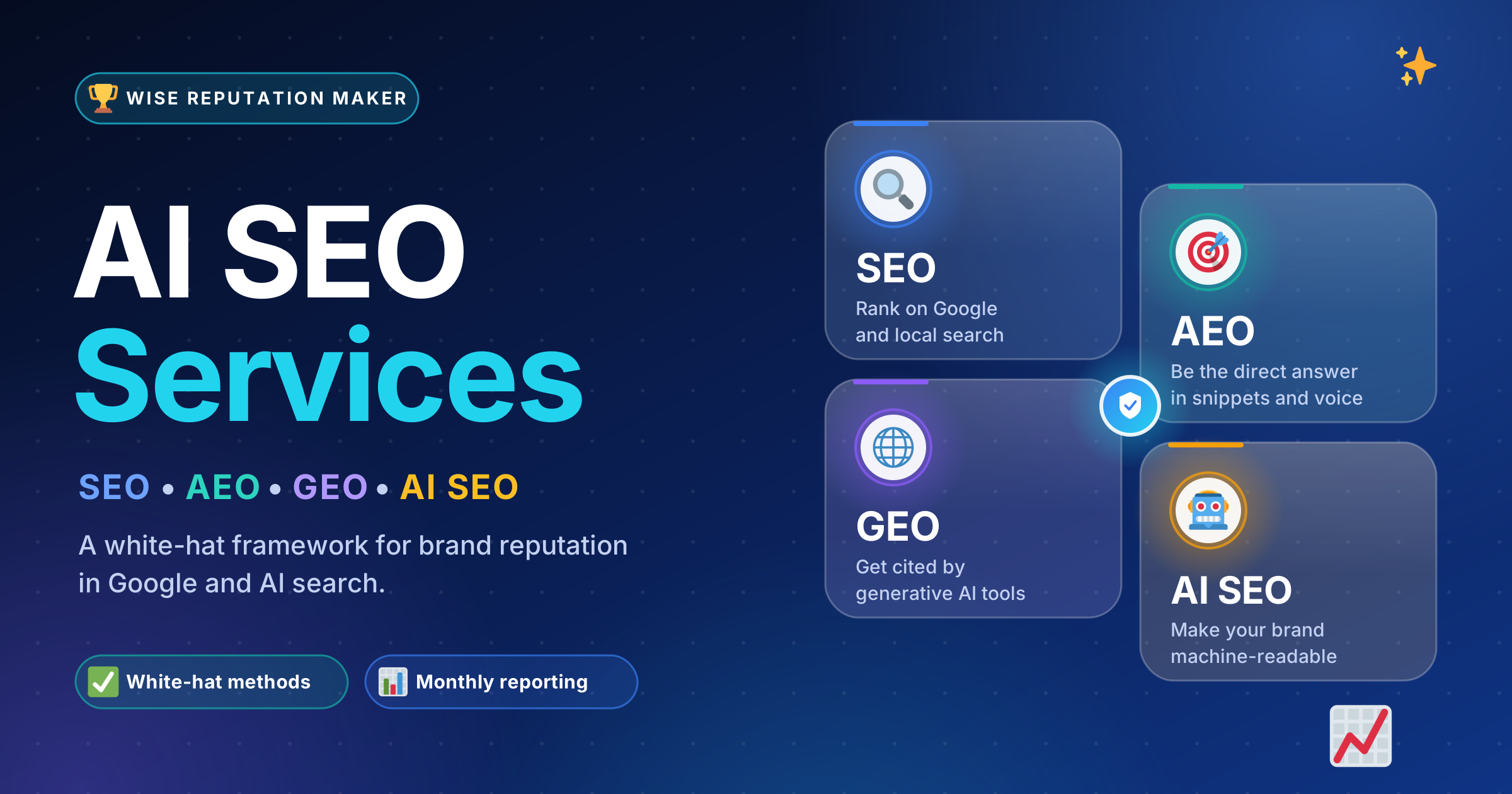
People now find brands through two systems at once. Traditional search engines rank pages, while AI systems such as Google’s AI Overviews, ChatGPT, and Gemini summarize, compare, and recommend. Modern AI SEO services aim to perform well in both, guided by one principle: whatever search shows about your brand should be accurate, consistent, and credible.
This article explains how SEO, AEO, GEO, and AI SEO differ and connect, what each involves in practice, and how to tell whether a search program protects your reputation or only chases rankings.
Why Search is Now a Reputation Channel
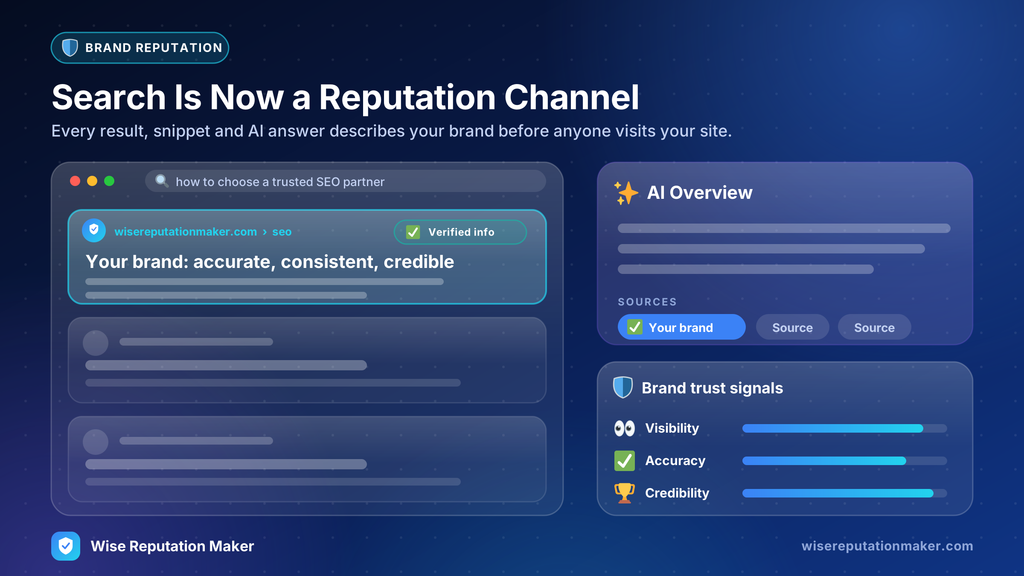
A search result, a featured snippet, and an AI-generated answer all do the same job: they describe your brand to someone who has not yet met you. The reader rarely sees how that description was put together, only the result.
That changes the standard for search work. Ranking first for a keyword has limited value if the surrounding information is outdated, contradictory, or thin. Search programs now need to manage three things together:
- Visibility: whether your brand appears for the queries that matter.
- Accuracy: whether the facts shown about you are correct and consistent.
- Credibility: whether independent sources support what you say about yourself.
The Four Disciplines at a Glance
| Discipline | Primary question | Where it shows up | Core levers |
| SEO | Can search engines find, understand, and rank our pages? | Google and Bing results, local packs | Technical health, content, links, local presence |
| AEO | Is our content the best direct answer to a specific question? | Featured snippets, People Also Ask, voice assistants | Question-led structure, concise answers, structured data |
| GEO | Do generative tools consider us a source worth citing? | AI Overviews, ChatGPT, Gemini | Entity clarity, topical authority, third-party validation |
| AI SEO | Can machines reliably read, interpret, and reuse our information? | All of the above | Schema, crawl access, consistent entity data, content structure |
These are not competing strategies. SEO is the foundation; AEO and GEO extend it into answer-driven and generative environments, and AI SEO is the technical and editorial layer that lets machines read the whole system.
SEO: The Foundation Everything Else Depends on
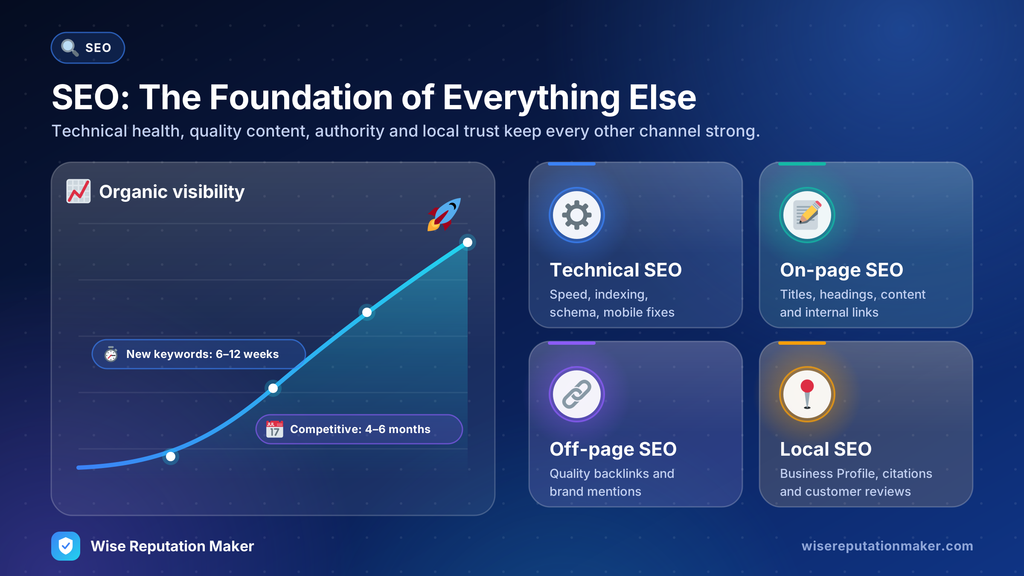
AI systems draw on the same open web that search engines index. If your site is slow, poorly structured, or thinly written, neither will treat it as a dependable source. A rigorous SEO program covers four workstreams.
Technical SEO. Crawlability and indexation, page speed, mobile usability, broken links and redirects, canonical handling, and schema implementation. This is where many sites lose visibility without anyone noticing.
On-page SEO. Title tags, meta descriptions, heading hierarchy, content depth, and internal linking. The aim is for each page to answer one clear intent better than competing pages do.
Off-page SEO. Quality backlinks and brand mentions from relevant, reputable publications and directories. Authority earned this way is also what generative systems look for when choosing whom to cite.
Local SEO. Google Business Profile accuracy, consistent name, address, and phone data across citations, and an active review profile. For service businesses, this is often the first reputation signal a customer sees.
AEO: Structuring Content to be the Answer
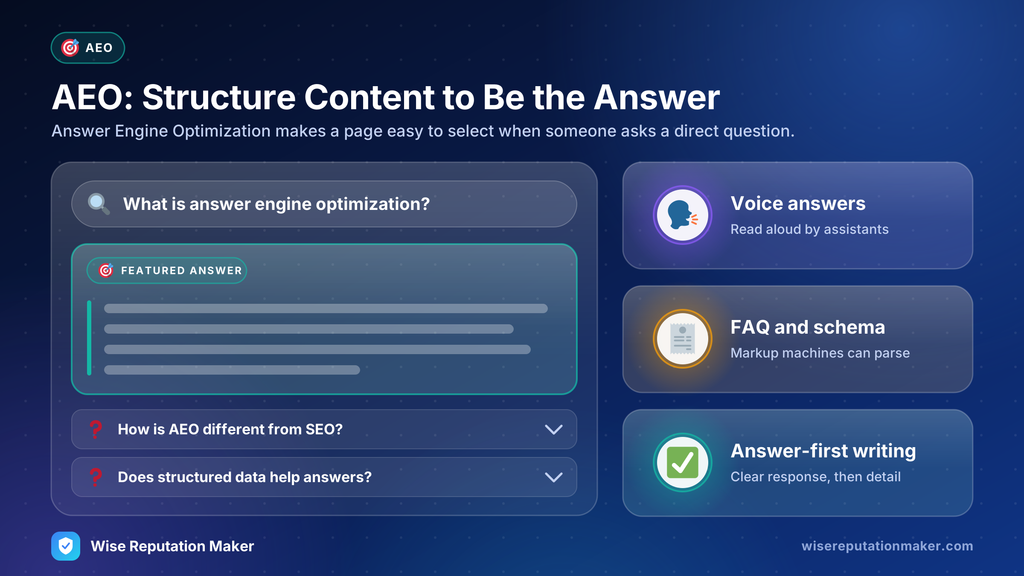
Answer Engine Optimization is about making a page easy to select when someone asks a direct question. Effective AEO work is editorial and structural rather than cosmetic.
- Map real questions to each service and topic, using search data, customer inquiries, and sales conversations.
- Lead with the answer. Place a clear, self-contained response of roughly 40 to 60 words directly under a question-style heading, then expand with context.
- Use supporting formats such as steps, definitions, and comparison tables where the question calls for them.
- Add FAQ and related structured data so machines can identify the question and its answer without guessing.
- Keep every factual claim consistent across pages, so no two answers on your site contradict each other.
The reputation benefit is that when a search engine quotes you directly, it uses your wording instead of someone else’s interpretation of your business.
GEO: Earning Citations from Generative Systems
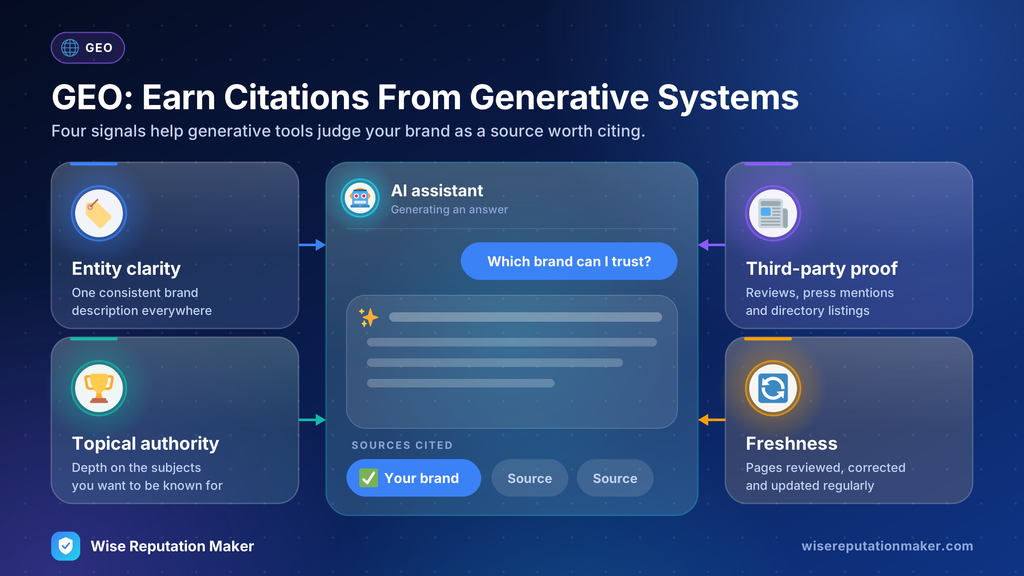
Generative engines assemble answers from sources they judge reliable. No brand can force a mention, but a brand can become the most dependable option available. GEO concentrates on four signals:
1. Entity clarity. Your brand name, services, locations, leadership, and positioning are described the same way on your website, profiles, and listings.
2. Topical authority. You publish substantive, original material on the subjects you want to be associated with, rather than scattered posts.
3. Third-party corroboration. Independent reviews, press mentions, directory listings, and references confirm your claims.
4. Freshness and maintenance. Pages are reviewed, corrected, and updated as services and facts change.
GEO is where SEO and reputation management overlap most. A brand with credible reviews, accurate listings and consistent messaging is easier for any system to describe correctly.
AI SEO: Making Your Information Machine Readable
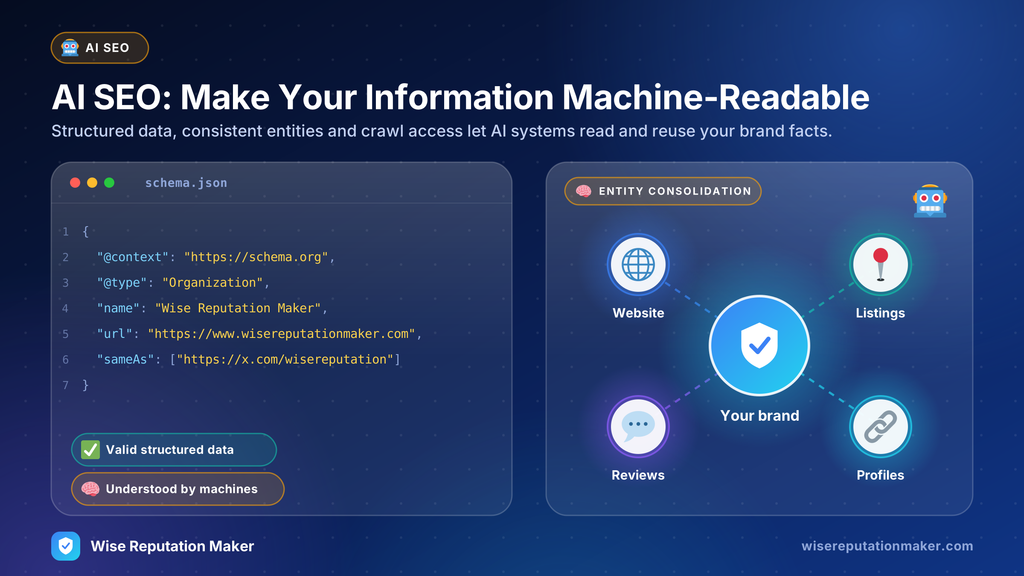
The AI SEO layer makes sure that what you publish can be parsed and reused reliably. Typical deliverables include:
- Structured data for organization, services, FAQs, reviews, and articles, validated for errors.
- Crawl and access review to confirm that important pages are reachable and that technical directives are not unintentionally blocking useful content.
- Entity consolidation, to align brand details across the website, social profiles, business listings, and knowledge sources.
- Content restructuring, with clear headings, short paragraphs, defined terms, and scannable formats.
- Source attribution and clarity, so claims, authorship, and dates are easy to verify.
The WRM Approach: Audit, Strategy, Execution, Tracking
Wise Reputation Maker, or WRM, is a team of SEO and digital marketing specialists, and its “AI SEO services” follow a four-stage process built on ethical, white-hat methods.
| Stage | What it involves |
| 1. SEO audit | A review of technical health, content quality, backlink profile, keyword coverage, and competitor positioning, with AEO and GEO readiness assessed alongside. |
| 2. Custom strategy | A roadmap covering on-page, off-page, technical, and local SEO, prioritized against the client’s commercial goals rather than a generic template. |
| 3. Execution | Page optimization, technical fixes, content publishing, and quality link building are carried out month by month against an agreed plan. |
| 4. Track and improve | WRM tracks rankings, traffic, and leads and refines the plan every month, with a clear report documenting progress. |
Monthly work typically covers on-page optimization; technical fixes for speed, indexing, schema, and mobile; off-page link and mention building; local profile and review management; and transparent reporting. WRM commits to a clear strategy, honest reporting, no shortcuts, and no hidden fees.
How to Measure Progress
Rankings alone no longer describe performance. A balanced scorecard includes:
- Search visibility: rankings and impressions for priority keywords.
- Traffic quality: organic sessions and engagement on commercial pages.
- Business outcomes: inquiries and leads attributed to organic search.
- Answer presence: featured snippets and related answer placements won.
- AI representation: how your brand is described when relevant questions are asked in AI tools, reviewed periodically for accuracy.
- Reputation signals: review volume and sentiment, listing accuracy, and brand-mention quality.
Realistic Timelines
Responsible search work is honest about timing. New keywords generally begin to move within 6 to 12 weeks. Competitive terms can take 4 to 6 months. Both depend on your industry, your competition and the current health of your website.
Rankings are decided by search engines, so no provider can guarantee a #1 position. A credible provider commits to process, quality, and transparency instead. In most cases, an existing website can be improved rather than rebuilt, and where there are serious structural problems, a good partner explains exactly what needs fixing and why.
Common mistakes brands make
- Treating AEO and GEO as separate from SEO, which leaves them built on a weak foundation.
- Publishing volume instead of depth, creating many shallow pages that dilute authority.
- Inconsistent brand data, with different names, addresses, or descriptions across platforms.
- Neglecting reviews and listings, which are major trust inputs for both search engines and AI tools.
- Chasing shortcuts, such as low-quality links, which create long-term risk to the brand.
- Measuring only rankings and missing whether visibility is turning into trust and inquiries.
What to Look for in a Provider
When evaluating AI SEO services, a few questions help separate real substance from buzzwords:
- Is the work strictly white-hat, with methods explained plainly?
- Does the scope include technical, on-page, off-page, and local SEO, not just one area?
- Are AEO and GEO described as specific, repeatable actions?
- Is reporting monthly and tied to leads and outcomes?
- Are fees transparent?
- Does the provider avoid guaranteed-ranking claims?
Frequently Asked Questions
What do AI SEO services include?
A complete program combines technical, on-page, off-page, and local SEO with AEO, GEO, and the machine-readability work of AI SEO, so your brand can rank in search and be understood by AI-driven tools.
How is GEO different from AEO?
AEO structures individual pages to be chosen as a direct answer to a specific question. GEO builds the broader authority, consistency, and third-party validation that make generative tools more likely to cite your brand.
Do AI SEO services replace traditional SEO?
No. Traditional SEO remains the foundation. The AI-focused layers extend it so your content performs in answer-led and generative search.
How soon will results appear?
New keywords usually move in 6 to 12 weeks, and competitive keywords can take 4 to 6 months, depending on competition and site health.
Can you guarantee a #1 ranking?
No. Google decides rankings, and anyone promising #1 is not being honest. A reliable partner promises a clear plan, ethical work and transparent monthly reports.
Conclusion
Search is increasingly where brands are summarized, compared and recommended, often without anyone visiting their website. AI SEO services that bring SEO, AEO, GEO and AI SEO together under one reputation-first strategy help keep those summaries accurate, current and credible.
To explore how WRM can support your search visibility and brand reputation, review our SEO services and Brand Reputation Management pages, or contact our team for a consultation.
