A social media marketing agency plans, creates, publishes, and measures a brand’s social media activity so that the business earns visibility, credibility, and customer inquiries. Social platforms now influence how people discover brands, how they judge them and how AI answer engines describe them. This guide covers the research behind that shift, the services a professional team delivers, tactics for each platform, the metrics that prove progress, and the standards that protect reputation. It draws on published studies and the working methods of Wise Reputation Maker.
Why Social Media Now Shapes Brand Reputation
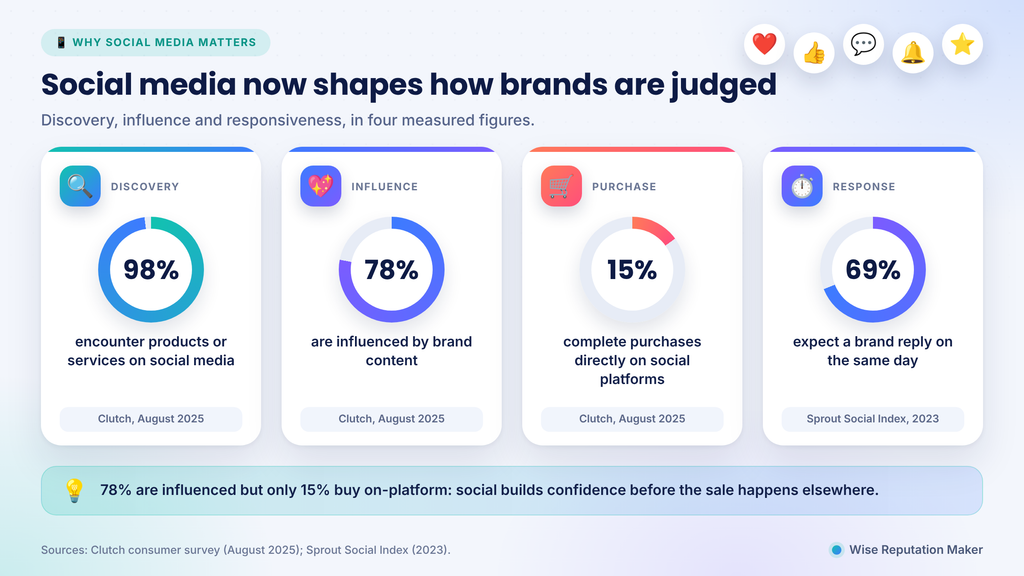
Social media shapes brand reputation because it is where many people first meet a brand, where they judge how it behaves and where they expect it to respond. Published research shows three measurable effects: discovery, influence, and responsiveness.
| Finding | Figure | Source |
| Consumers who encounter products or services on social media | 98% | Clutch, August 2025 |
| Consumers influenced by brand content | 78% | Clutch, August 2025 |
| Consumers who complete purchases directly on social platforms | 15% | Clutch, August 2025 |
| Consumers who expect a brand reply on the same day | 69%, against 77% a year earlier | Sprout Social Index, 2023 |
The gap between 78% influenced and 15% purchasing on-platform suggests that most social activity builds confidence before a sale happens elsewhere, on a website, by phone, or in person. A profile therefore works as a reputation asset first and a sales channel second. The same Sprout Social research found that a growing share of consumers expect replies within minutes or hours, which turns community management into a visible measure of how a brand treats people. Survey sizes and limits are listed in the Sources section.
How AI answers surface brands and where social media fits
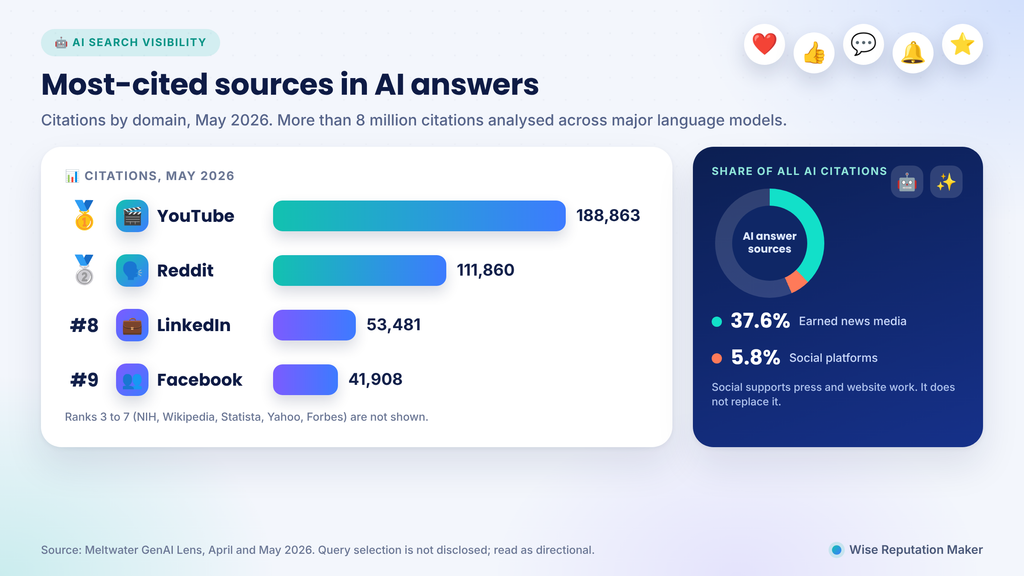
AI answer engines draw on a mix of news coverage, reference sites, and social platforms. In Meltwater’s analysis of more than 8 million citations across major language models in April and May 2026, YouTube and Reddit were the two most-cited domains. Social platforms as a category accounted for 5.8% of citations in May, behind earned news media at 37.6%, so social visibility supports press and website work rather than replacing it.
| Rank | Source | Citations, May 2026 | Change on April |
| 1 | YouTube | 188,863 | Up 56.4% |
| 2 | 111,860 | Up 13.0% | |
| 8 | 53,481 | Down 9.7% | |
| 9 | 41,908 | Up 4.4% |
Citation habits differ by model. The same report found that Google AI Mode leans heavily on YouTube, Reddit, LinkedIn, and Facebook, while Perplexity draws on YouTube, Wikipedia, and NerdWallet and avoids Reddit. Meltwater does not disclose how queries were selected, so the figures are best read as a directional guide rather than a fixed ranking.
For a brand, the practical implications are:
- Keep one consistent identity. Use the same brand name, description, and website link on every profile so that engines can connect separate mentions to a single organization.
- Answer real questions on YouTube. Clear titles, descriptions, and captions make videos easier to interpret and cite.
- Participate honestly on Reddit. Useful, transparent contributions build credibility in communities that engines frequently reference.
- Use LinkedIn to state expertise. Company pages and posts give B2B brands a verifiable record of what they know and do.
- Link social activity back to owned pages. Profiles and videos should point to service pages and articles that hold the full, accurate detail.
What does a social media marketing agency do?
A professional “social media marketing agency” manages the full cycle of a brand’s social presence: research and strategy, content creation, daily account management, community engagement, paid advertising, and monthly reporting. Its purpose is to build an audience that trusts the brand and then converts that trust into customer inquiries.
Wise Reputation Maker delivers this work across Instagram, Facebook, LinkedIn, YouTube, and Reddit. Every plan is custom-built, handled by real specialists and backed by clear monthly reports. In a typical engagement, each service produces a specific output and is judged by a specific measure:
| Service | What the team does | What you receive | How it is judged |
| Audit and research | Review your accounts, audience, and competitors. | Findings on profile quality, content performance, and competitor positioning | A baseline for engagement and follower quality |
| Custom strategy | Matches goals to platforms and content themes | A content and campaign plan for each chosen platform | Each theme tied to a stated business goal |
| Content creation | Design graphics, videos, captions, and hashtags from your photos, offers, and ideas. | A monthly content set ready for approval | Engagement rate, saves, shares, and video watch time |
| Publishing and daily management | Maintains the content calendar and posts on schedule | Posts published on the agreed cadence | Posting consistency and reach |
| Community engagement | Replies to comments and messages | Responses within agreed time windows | Response time, response rate, and reply sentiment |
| Paid advertising | Runs paid campaigns when included in the plan | Campaign setup, audience selection, and creative variants | Click-through rate, cost per lead, and lead volume |
| Monthly reporting | Compiles and interprets results | A report on reach, engagement, followers, and leads, with next-month actions | Progress against the goals set in the strategy |
Platform Playbook: Matching Tactics to Where Your Customers Are
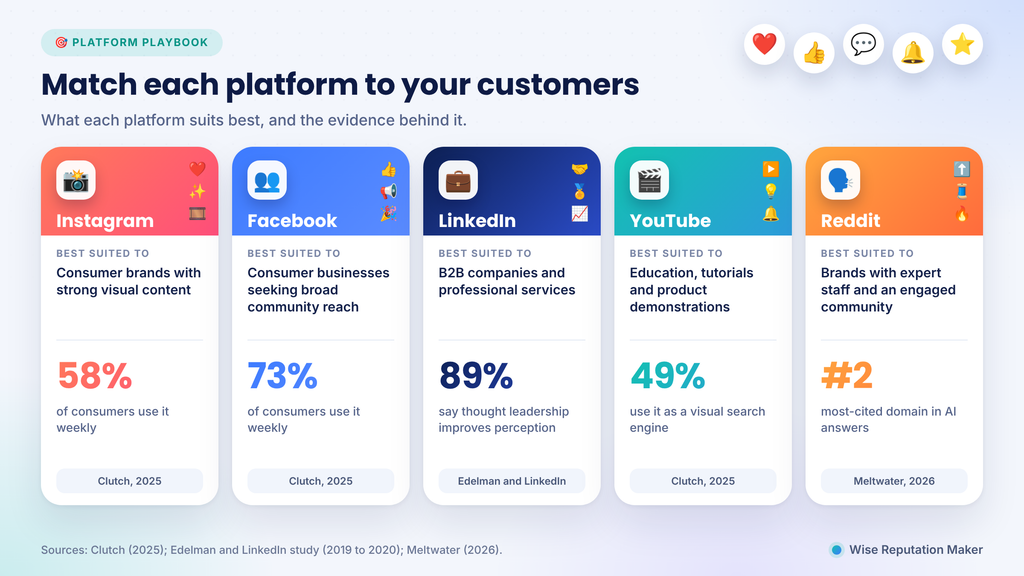
Platform choice should follow customer behavior, not habit. Instagram and Facebook suit most consumer businesses, LinkedIn suits B2B and professional services, and YouTube suits education and product demonstrations. Wise Reputation Maker recommends only the platforms that make sense for the brand. The table shows what each platform rewards and the reputation risk that needs managing.
| Platform | Best suited to | Tactics that fit | Supporting evidence | Reputation risk to manage |
| Consumer brands with strong visual content | Reels, carousels, and stories are built to be watched to the end and sent to others. | Instagram head Adam Mosseri named watch time, likes, and sends as the top three ranking signals in January 2025; 58% of surveyed consumers use it weekly, according to Clutch. | Inconsistent visuals and unanswered comments or messages | |
| Consumer businesses seeking broad community reach | Page posts, videos, community replies, and paid campaigns | 73% of surveyed consumers use it weekly, according to Clutch. | Slow replies on a public page | |
| B2B companies and professional services | Expert commentary, practical insights and company updates | In an Edelman and LinkedIn study of 3,275 decision-makers, 89% said thought leadership improves their perception of an organisation and 59% found it more trustworthy than marketing materials | Generic content: only 15% rated most thought leadership as very good or excellent | |
| YouTube | Education, tutorials, and product demonstrations | Explainers and demonstrations with clear titles, descriptions, and captions | 49% of surveyed consumers use it as a visual search engine, according to Clutch, the most-cited domain in Meltwater’s data. | Outdated or inaccurate videos that stay live |
| Brands with knowledgeable staff and an audience that values discussion | Transparent participation and useful answers within each community’s rules | Second most-cited domain in Meltwater’s data | Promotional posts that communities may criticize or remove |
Instagram’s ranking guidance adds a useful detail: Mosseri said likes carry more weight for content shown to followers, while sends carry more weight for reaching people who do not yet follow the account. Content designed to be shared privately therefore supports reach, and content designed to be liked supports the existing audience. The Edelman and LinkedIn study dates from 2019 and 2020, so its figures describe long-term B2B buying attitudes rather than current platform behavior.
The Four-Step Process Behind Reliable Social Media Growth
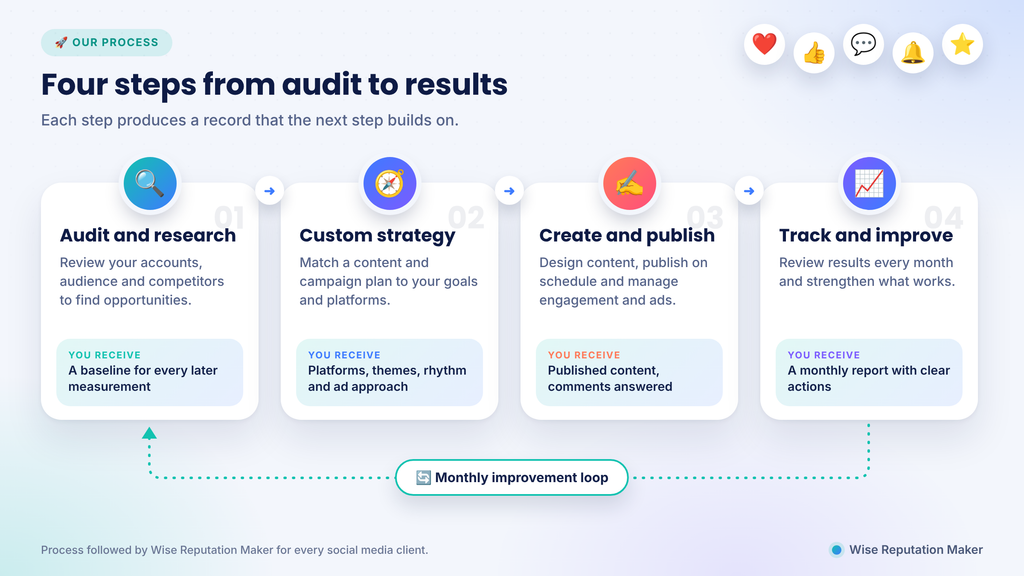
Wise Reputation Maker follows a four-step process: audit and research, custom strategy, creation and publishing, and tracking and improvement. Each step produces a record that the next step builds on, which is what separates a dependable social media marketing agency from a service that only posts content.
| Step | What happens | What the client receives |
| 1. Audit and research | The team reviews your accounts, audience, and competitors to find opportunities. | Findings and a starting baseline for every later measurement |
| 2. Custom strategy | A content and campaign plan is matched to your goals and the platforms that suit your customers. | A plan covering platforms, content themes, publishing rhythm, and ad approach |
| 3. Create and publish | Specialists design content, publish on schedule, and manage engagement and paid ads. | Content published against an agreed calendar, with comments and messages answered |
| 4. Track and improve | Results are reviewed every month, and what works is strengthened. | A monthly report with clear actions for the following month |
The audit matters most because it sets the baseline. Without a record of where engagement, follower quality, and inquiries stood at the start, later progress cannot be demonstrated, and a client cannot tell which activity produced it.
Measuring What Matters: A Reporting Framework
A useful monthly report answers three questions: are more of the right people seeing the brand, do they trust it enough to engage, and are they making inquiries? Wise Reputation Maker’s monthly reports cover reach, engagement, followers, and leads. The framework below shows how those headline figures connect to reputation.
| Objective | Metric | What it shows | Typical source |
| Reputation | Response time and response rate | Whether the brand answers the people who contact it | Platform inboxes and comment threads |
| Reputation | Sentiment of comments and mentions | Whether the audience’s tone is positive, neutral or negative | Manual review or social listening tools |
| Reach | Reach, impressions and video watch time | How many people see the content and whether they stay | Platform analytics |
| Engagement | Engagement rate, saves and shares | Whether content is useful enough for people to act on | Platform analytics |
| Audience quality | Follower growth relative to engagement | Whether the audience is real and interested | Platform analytics |
| Demand | Leads, enquiries and referral traffic | The contribution to business results | Enquiry forms, calls and tagged links |
A strong report also states how each metric is calculated, because definitions differ slightly between platforms, and it ends with specific actions rather than a list of numbers.
Organic and Paid Social: Roles, Timelines and Budget
Organic content builds trust and community, while paid advertising speeds up reach and lead generation. Engagement and reach often improve within 4 to 8 weeks, and steady follower growth and leads usually take 3 to 6 months. Paid advertising can deliver faster results. Timeframes vary with industry, budget and the condition of the accounts at the start.
| Aspect | Organic social | Paid social |
| Main job | Builds trust, community and a library of useful content | Extends reach and accelerates lead generation |
| Speed | Engagement in 4 to 8 weeks; steady growth in 3 to 6 months | Often faster than organic |
| Cost | Content creation and management time | Management time plus an ad budget that can start small |
| Best used for | Reputation, relationships and answering customer questions | Launches, offers and reaching new audiences |
| Limitation | Compounds gradually | Reach generally stops when spending stops |
Many businesses see the strongest results from a combination of both. A sensible approach is to begin with a modest ad budget alongside organic content, review the cost per lead each month and expand spending only where the data supports it.
Community Management and Reputation Protection
Community management protects reputation because every public reply is visible to future customers as well as to the person who wrote the comment. With 69% of consumers expecting a same-day response in Sprout Social’s 2023 research, a clear response standard is part of brand quality, not an optional extra.
A reliable sequence for handling a negative comment or complaint is:
1. Acknowledge quickly and calmly. A short, factual public reply shows the brand is listening.
2. Move private details out of public view. Direct messages or a phone call suit account-specific issues.
3. Resolve or set expectations. Fix the problem, or state clearly what will happen and by when.
4. Close the loop. Follow up once the matter is resolved, publicly where appropriate.
5. Record the pattern. Repeated complaints belong in the monthly report so the underlying cause can be addressed.
Ethical practice matters just as much as response speed. Wise Reputation Maker’s promise is creative content, honest reporting and ethical growth methods, with no fake followers, no shortcuts and no hidden fees. Purchased followers inflate numbers without producing real engagement and can leave a brand looking less credible to genuine customers. A responsible social media marketing agency treats audience quality, real conversation and transparent reporting as the foundation of lasting reputation.
Social media work also sits alongside the wider disciplines of online reputation management and brand reputation management. Social activity shapes what a brand says and how it responds, while those services protect how the brand appears across search results and review platforms.
How to Evaluate a Social Media Marketing Agency
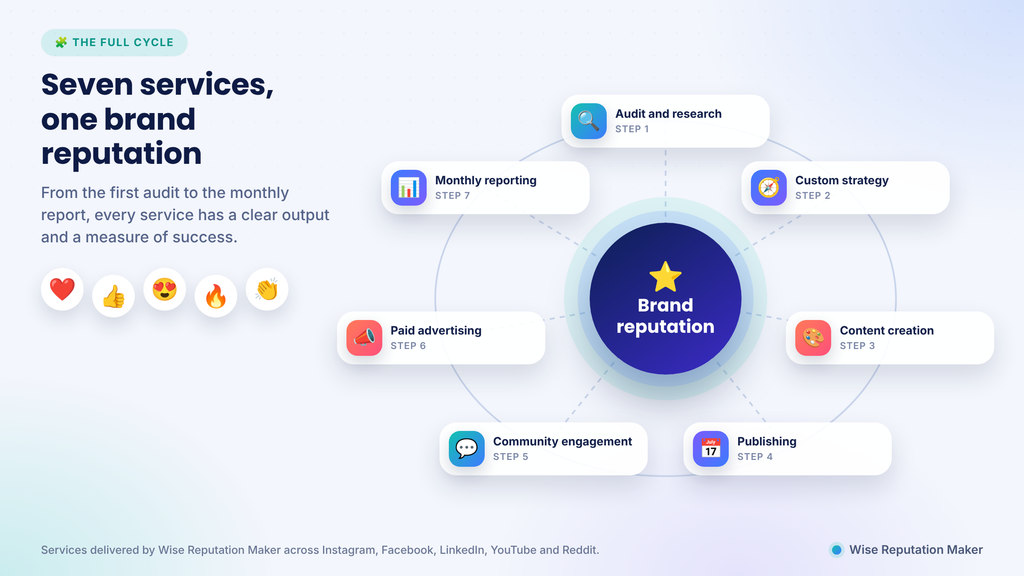
A trustworthy agency can explain its strategy, show its reporting and recommend platforms based on your audience rather than on habit. Seven questions, with the answers to look for and the warning signs to avoid, make the comparison practical.
| Question to ask | A strong answer | A warning sign |
| How will you begin? | An audit of accounts, audience and competitors, with a recorded baseline | A content calendar offered before any research |
| Which platforms will you recommend? | Only those where my customers are, with reasons | Every platform recommended by default |
| Who creates the content? | Named specialists design graphics, videos, captions and hashtags | Unclear responsibilities or reused templates |
| How will I see progress? | A monthly report on reach, engagement, followers and leads, with actions | Screenshots of follower counts alone |
| How do you grow an audience? | Useful content and genuine engagement | Guaranteed follower numbers |
| What will it cost? | Clear pricing with no hidden fees | Add-on charges that appear after sign-up |
| How do you handle comments and complaints? | Agreed response windows and an escalation path | No stated response process |
Frequently Asked Questions
What does Wise Reputation Maker do for my social media each month?
Each month the team plans your content calendar, designs and publishes posts, and replies to comments and messages. Paid ads run if they are part of your plan, and a report shows reach, engagement, followers and leads.
Which social media platforms should my business use?
The answer depends on your customers. Instagram and Facebook suit most consumer businesses, LinkedIn works best for B2B and professional services, and YouTube suits education and product demonstrations. Only the platforms that make sense for your brand are recommended.
How soon will I see results?
Engagement and reach often improve within 4 to 8 weeks. Steady follower growth and leads usually take 3 to 6 months, and paid ads can bring faster results.
Do I need paid ads, or is organic posting enough?
Organic content builds trust and community, while paid ads speed up reach and leads. Many businesses achieve the best results with a mix of both, and a plan can start with a small ad budget.
Do I need to create the content myself?
No. Wise Reputation Maker creates the graphics, videos, captions and hashtags. You can share photos, offers and ideas, and the team turns them into polished posts.
Does social media marketing improve brand reputation?
It can, when the activity is consistent, useful, responsive and honest. In Clutch’s 2025 survey, 78% of consumers said brand content influenced them. Follower counts alone do not measure reputation, so engagement quality, response times and comment sentiment should be tracked as well.
Can social media activity affect how AI answer engines describe my brand?
It may contribute. Meltwater’s 2026 analysis found YouTube and Reddit among the most-cited sources in AI answers, although social platforms made up 5.8% of all citations. Consistent profiles, clear video descriptions and accurate links to your website help engines interpret your brand, but no agency can guarantee how any engine cites it.
Conclusion: Build a Brand People Trust
Social media now influences how brands are discovered, judged and described, and the evidence shows that consistency, responsiveness and honest measurement matter more than follower counts. Wise Reputation Maker’s mission is to help every client build a trusted, active and recognisable brand on social media that attracts the right customers. The company reports more than 1,000 satisfied clients, over 500 brand reputations built or improved and more than 37,000 hours delivered.
To strengthen your brand’s presence across Instagram, Facebook, LinkedIn, YouTube and Reddit, explore the Social Media Marketing service or contact Wise Reputation Maker for a free consultation.
